Bought an auto lemon in California? Most lemon owners have to do more to get a refund.

CONSUMER ALERT for California auto and recreational vehicle lemon owners!! Don’t get stuck with a defective lemon car because you skipped this step.

Auto and RV manufacturers won major changes to California’s auto lemon law that make it harder for most owners of seriously defective “lemon” vehicles to get warranty repairs or a refund. The changes apply to lemon owners who purchase vehicles from:

General Motors, Ford, Fiat Chrysler / Stellantis (FCA), Hyundai, Infiniti, Isuzu, Kia, Mercedes-Benz, Mitsubishi, Nissan, Subaru, and other manufacturers who opted in to the new, anti-consumer version of the law.

The California Department of Consumer Affairs has posted a list of auto manufacturers who opted in to the new law. If the manufacturer of your car is on the list, your life as a consumer is now more complicated.

Before the changes to the law took effect, all you had to do was to take your faulty car to a manufacturer-authorized repair facility (usually one of their franchised dealerships) for repairs. The manufacturers were responsible for tracking the repairs and offering to “promptly” buy back vehicles that qualified as lemons. That makes sense, since the manufacturers are the ones that produce the defective vehicles.  They also review and approve warranty repairs, including reimbursing their dealers for performing repairs. Plus they have their own attorneys, who should be familiar with the lemon law.

What has changed? 

Now, most lemon owners are required to also notify the manufacturer directly, IN WRITING, in order to have the full protection of the lemon law. You must provide specific information, including:

  • The vehicle owner’s name.
  • The Vehicle Identification Number, or VIN, which must be “accurate.” You can find the VIN on a plate on the dashboard, and in the sales documents. It’s 17 numbers and letters. Take time to double-check that the VIN is correct.
  • A “brief summary of the repair history and problems with the vehicle.” It’s not clear from the new law exactly what will do the job. We suggest that you provide a complete list of all the problems that you have experienced, and of each of the times you attempted to get the vehicle fixed.
  • A demand that the manufacturer buy back the lemon, or provide a replacement vehicle.  It’s not enough to tell the dealer or manufacturer “I don’t want this car anymore,”  “I’m afraid to drive this car,” or “This car is a lemon.” You need to tell the manufacturer IN WRITING that you are demanding a buy back or replacement vehicle.

You must send this written message to one of two places:

By email:  to the email address that the manufacturer of your defective vehicle has provided, which shows up on this list.

By snail mail: “by certified or registered mail, return receipt requested, to the address provided by the manufacturer in the owner’s manual or warranty booklet.” The contact name and mailing address are also posted here, on the website for the California Department of Consumer Affairs.

When you send the written notice, you must still have possession of the vehicle, so don’t wait until you have traded it in to the dealership or sold it to someone else. You are also required to keep the car for at least 30 days from when the manufacturer has received the written notice.*

Plus you must inform the buyer IN WRITING about the problems you experienced with the car — even if it’s the dealer where you’ve been taking the car for repairs.**

Is calling the manufacturer’s toll-free number enough? NO!!

Even if you have called the manufacturer’s customer service number over and over again, and talked to agents of the manufacturer who say they have opened a case in your name, and they will get back to you, that is no longer enough to preserve all of the protections you need, under the lemon law. 

If you don’t send a written notice that complies with the new law, the manufacturer can get away with refusing to fix your lemon or buy it back, without facing the civil penalty for willfully violating the lemon law. The possibility of having to pay a penalty is the #1 incentive for manufacturers to do the right thing when you have a lemon. Unless they face a significant penalty, they have little to lose by failing to fix your car or give you a refund.

Why do auto manufacturers want you to have to write directly to them, before you can benefit from the lemon law?

The reason the manufacturers desired a change in the law to require lemon owners to write to them directly was to make it super easy for them to screen out vehicle owners who haven’t taken that additional new step, and refuse to pay for warranty repairs to fix their cars — reducing their warranty costs. 
 
Auto manufacturers know that most lemon owners will not be aware of the new requirement, or write to them and provide all of the required information, so they can get away with stonewalling and giving consumers the run-around, in hopes they will give up and trade in their defective cars at a huge loss.
 
Not surprisingly, the auto manufacturers who steered the lobbying effort to weaken California’s auto lemon law have the worst record of producing the most lemons, having to issue the most safety recalls, and having the highest warranty costs.
 
General Motors and Ford steered the battle to change the law. In the first half of 2025, Ford had warranty costs of over $2.8 billion and GM had warranty costs of over $2.5 billion.
 
In 2025, Ford broke records for having to issue safety recalls, recalling nearly 13 million vehicles due to serious safety defects — more than the next 9 auto brands combined.
 
How did the auto manufacturers get CA legislators to vote for weakening the lemon law?
 
For decades, CARS succeeded in not only blocking anti-consumer changes to California’s auto lemon law, but in expanding the law to cover vehicles purchased for business use and to include protections for military servicemembers stationed in, or deployed from, California.  
 
However, the Consumer Attorneys of  California (CAOC) sided with GM and Ford over the changes to the law, under threat of a ballot initiative that would have capped their attorneys’ fees — threatening their incomes.
 
The changes to the law were introduced using a sleazy tactic called a “gut-and-amend”  — stripping out the contents of a bill on an unrelated topic, and inserting the unpopular provisions — just two weeks before the end of the legislative session, when the fate of hundreds of bills was being decided all at once.  Many legislators complained about the unfair, rushed process and having to make a decision on such an important issue without the usual months-long scrutiny such a bill should get.
 
CARS worked night and day and fought back hard against the changes, which were also opposed by manufacturers such as Toyota (which produces relatively few lemons compared with GM and Ford), but most legislators caved in to GM, Ford, and the CAOC. Notable exceptions, who sided with consumers: Assemblymembers Rebecca Bauer-Kahan, Dr. Jasmeet Bains, Jacquie Irwin, and Cottie Petrie-Norris, and Senators Marie Alvarado-Gil, Angelique Ashby, Susan Talamantes Eggman, and Roger Niello.
 
Governor Newsom expressed reservations about the bill and insisted that the legislature enact another bill (SB 26) to allow auto manufacturers to opt out, as a condition of signing the bill.
 
 
* Here’s the actual quotation from the GM-Ford-CAOC changes to the lemon law (AB 1755):
 
California Code of Civil Procedure Section 871.24.
 (a) At least 30 days prior to the commencement of an action seeking civil penalties under subdivision (c) of Section 1794 of the Civil Code, the consumer shall do all of the following:
 
(1) Notify the manufacturer of the consumer’s name, the accurate Vehicle Identification Number (”VIN”) of the motor vehicle, and a brief summary of the repair history and problems with the motor vehicle.
 
(2) Demand that the manufacturer repurchase or replace the motor vehicle.
 
(b) Minor deviations in the notice submitted pursuant to subdivision (a) shall not disqualify consumers from seeking civil penalties.
 
(c) At the time that notice submitted pursuant to subdivision (a) is sent, the consumer shall have possession of the motor vehicle.
 
(d) The notice required by subdivision (a) shall be in writing and shall be sent either by email to the email address prominently displayed on the manufacturer’s website for this purpose or by certified or registered mail, return receipt requested, to the address provided by the manufacturer in the owner’s manual or warranty booklet. The notice information on the manufacturer’s website, owner’s manual, and warranty booklet shall be provided in both English and Spanish.
 
** Here’s the actual quotation from the opt-out bill, SB 26, that requires auto lemon owners to inform the buyers IN WRITING about the problems with the vehicle and any legal action they may bring — even if the buyer is the dealer who has been attempting to repair the car, and is already familiar with its history.
 
(i) If a consumer sells their vehicle as authorized by subdivision (g), the consumer may not seek civil penalties under subdivision (c) of Section 1794 of the Civil Code unless the consumer provided to the prospective buyer or recipient of the vehicle, prior to the sale, written notice of the basis for the consumer’s request for restitution or replacement from the manufacturer and of any pending action described in subdivision (a) of Section 871.20.
 

CA on track to have the worst auto safety recall law in the nation

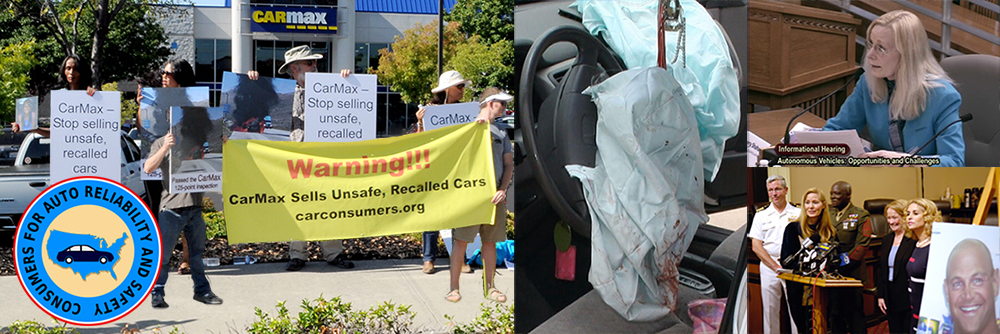
Greedy, unscrupulous car dealers are high-fiving themselves, as Democratic and Republic legislators in California continue to vote unanimously to legalize dealers’ sales of unsafe, recalled used cars with lethal safety defects to consumers.

Testifying against the car dealers’ bill: Cally Houck, who lost her two daughters, Raechel and Jacqueline, ages 24 and 20, due to a recalled car.  A steering hose leaked, causing an under-hood fire and a loss of steering control.  The two sisters ended up colliding head-on with an 18-wheeler truck.

As their mother, Cally Houck, told legislators:  AB 287, the car dealers bill, “would protect dealers, not consumers.” The bill is being authored by Assemblymember Richard Gordon, who has said that his father and grandfather were car dealers.

Also testifying against the bill:  Mark Anderson, who testified on behalf of the National Association of Consumer Advocates. According to NACA, if the dealers win, California will become a dumping ground for unsafe, recalled cars that would be illegal for dealers to sell in other states.  That would translate into more fatalities and injuries, and higher risk for everyone who shares the roads.

According to the car dealers’ bill, the defect that killed Raechel and Jacquie would not be considered “serious.”

Read more:

Orange County Register: A record 64 million cars were recalled last year: Here’s what’s being done to make buying safer used cars

Ventura County Star: Capps introduces rental car bill named for Ojai sisters killed in crash

How serious are safety recalls?

How serious are auto safety recalls?  Ask anyone who has lost a family member, or been severely burned or rendered quadriplegic, as a result of a safety defect, and they can tell you that auto safety recalls should not be ignored.

The National Highway Traffic Safety Administration is working to improve safety recall repair rates. Their goal:  getting 100% of recalled vehicles repaired, the sooner the better. Auto manufacturers are joining in that effort and turning to social media, offering discount coupons, and advertising about safety recalls in multiple languages. All in an effort to persuade consumers take their cars for recall repairs.

However, car dealers in California are so intent on maximizing their profits, they are doing something breathtakingly irresponsible. They are claiming, publicly, that only about 1% of safety recalls are serious. Seriously. Why? They don’t want to frighten people from buying millions of cars with lethal safety defects, like air bags that are prone to exploding with excessive force, spewing metal fragments into drivers’ and passengers’ faces and necks, and blinding them or severing arteries, so they bleed to death.

Just because the cars are unsafe, and there aren’t enough repair parts available to replace the defective air bags, dealers argue that shouldn’t interfere with their selling the unsafe cars to teenagers as their first cars, or to families with young children.

All the more reason not to by a used car from a dealer. Who wants to spend 4 hours on a car lot dickering over cars, only to end up with a vehicle that has a lethal safety defect, and no repair parts available for months on end?

Read more: CBS News: Feds seek ideas on getting more safety recalls done

Caught on video: new car dealer lobbyist admits why they killed bill that would have improved the law against dealers selling unsafe, recalled used cars to consumers.

CARS’ tips for buying a safe, reliable used car without having to set foot on a car dealer’s lot


Car Dealers seek to legalize sales of unsafe recalled used cars

Faced with record numbers of recalled cars and lengthy shortages of repair parts, car dealers are pushing aggressively to weaken state laws that prohibit them from deceiving their customers into buying used cars with lethal safety defects.

Car dealers are eager to foist the unsafe cars off onto their customers, knowing that there is no way they will be able to get the serious safety defects repaired, for months on end. In one horrific case, a father, mother, 13-year-old daughter and brother-in-law were all killed within hours after the dealer handed them the keys to an unsafe car. The publicity surrounding that case led to Toyota’s issuing a massive safety recall, and eventually paying a record fine. However, the dealers do not seem capable of learning from that tragic incident and its aftermath.

Federal law prohibits car dealers from selling recalled NEW cars to consumers until they have been repaired.  There is no similar, specific federal law that prohibits dealers from selling recalled USED cars to consumers. However, broader, more generic state laws in every state, and some federal laws, prohibit merchants, including car dealers, from engaging in fraud, false advertising, unfair and deceptive acts and practices, anti-competitive behavior, reckless endangerment, negligence, and other shady practices. In addition, a whole body of case law exists that prohibits such illicit conduct.

The National Highway Traffic Safety Administration has charged some dealers with violating the federal law against selling recalled new cars to consumers. What’s next? Dealers trying to make that legal too?

KPIX-TV, the CBS affiliate in San Francisco, broadcast this news report about the car dealers’ highly controversial, anti-consumer, anti-safety bill in California. Be sure to watch for the reaction at the end, by the news anchors:

KPIX-TV: Car dealers fight back over recall disclosures


CarMax – Too Risky for Wise Investors?

Thinking of investing in CarMax? You may want to take a close look at their breathtakingly risky practice of selling unsafe, recalled cars to consumers.

CarMax is already under fire from consumer groups,  faces potential action by the Federal Trade Commission, and has been repeatedly exposed in undercover investigations by TV news organizations, including ABC’s 20/20, over its sales of unsafe, recalled cars to consumers.

Here’s the rub:  CarMax advertises that all their cars must pass a “rigorous 125+ point inspection” before they can be sold as “CarMax Quality Certified” cars.  But how can a car with a killer defect possibly pass a rigorous inspection and meet their standards?

Despite the mounting scrutiny, CarMax recklessly persists in selling “CarMax Quality Certified” unsafe, recalled cars at retail to consumers. Case in point:  Even when competitors like AutoNation have wisely announced their decision to cease selling used cars with unrepaired Takata air bags, CarMax continues to sell them anyway.

Defying common sense and responsible business practices, CarMax somehow seems unable to bring itself to stop selling consumers cars with the notoriously defective air bags, which can explode on impact, hurling shrapnel at the driver and front-seat passenger’s face and neck..  In cases that are making global headlines, the defective air bags have caused  serious injuries, including blindness, while other hapless victims have bled to death.

This particular defect  remains the focus of Congressional investigations in the U.S. Senate and House of Representatives. Takata also faces possible legal action by the National Highway Traffic Safety Administration, and by the US Department of Justice.

So — what does AutoNation know and take into account that CarMax doesn’t seem to grasp?

Is CarMax waiting for a total PR catastrophe, before they stop making that added bit of profit by selling lots of unsafe, defective, recalled cars to consumers, instead of having them repaired or selling them for a somewhat lower price, at wholesale?

Whatever CarMax’s motivation, wise investors may wish to rethink the company’s self-inflicted level of exposure.


NY Times: Ford issues safety recall, NHTSA upgrades investigation into Jeep fires

WARNING — FORD EDGE and CRYSLER JEEP owners:

“Ford recalled about 28,000 of its 2012-13 Edge crossover utility vehicles for possible fuel leaks on models equipped with the 2-liter 4-cylinder EcoBoost engine, according to a report posted on the National Highway Traffic Safety Administration website. The automaker said the fuel line pulse damper was not manufactured properly by a Michigan supplier, which could allow ‘fuel odor, seepage or a small fuel leak.’ ”

Caution: If you are buying a used vehicle, NEVER  rely on the auto dealer to ensure that the safety recall repairs have been performed. Car dealers have been caught over and over again selling unsafe, recalled cars, pickups, and SUVs.

One large new car dealership in California even sold one that was supposedly a  “certified” used car — that nearly killed the buyer when the safety defect occurred.

How can you find out if a vehicle has a pending safety recall? It’s easy — write down the Vehicle Identification Number and call a local dealer, or check the manufacturer’s website.

Read more: “NY Times report”

Dealers selling unsafe, recalled used cars


Chrysler refuses to recall its flaming Jeeps — Act Now!

Over 287 people have died in 202 fiery crashes involving 1993-2004 Jeep Grand Cherokees, more than the ill-famed Ford Pinto in the 1970s. Yet Chrysler continues to refuse to recall their flaming Jeeps.

Please help stop innocent people from being burned to death in Jeeps designed with the gas tanks behind the rear axle, where rear-end collisions cause the tanks to rupture and explode.

A courageous woman from Virginia who witnessed a horrific crash, which cost a mother and teenager their lives, has filed an online petition.  Once you read it, you’ll know why those Jeeps have to be recalled — and why it’s important to add your name to the growing list of concerned consumers calling on Chrysler to stop the carnage —

Here’s where you can sign Janelle’s petition