Bought an auto lemon in California? Most lemon owners have to do more to get a refund.

CONSUMER ALERT for California auto and recreational vehicle lemon owners!! Don’t get stuck with a defective lemon car because you skipped this step.

Auto and RV manufacturers won major changes to California’s auto lemon law that make it harder for most owners of seriously defective “lemon” vehicles to get warranty repairs or a refund. The changes apply to lemon owners who purchase vehicles from:

General Motors, Ford, Fiat Chrysler / Stellantis (FCA), Hyundai, Infiniti, Isuzu, Kia, Mercedes-Benz, Mitsubishi, Nissan, Subaru, and other manufacturers who opted in to the new, anti-consumer version of the law.

The California Department of Consumer Affairs has posted a list of auto manufacturers who opted in to the new law. If the manufacturer of your car is on the list, your life as a consumer is now more complicated.

Before the changes to the law took effect, all you had to do was to take your faulty car to a manufacturer-authorized repair facility (usually one of their franchised dealerships) for repairs. The manufacturers were responsible for tracking the repairs and offering to “promptly” buy back vehicles that qualified as lemons. That makes sense, since the manufacturers are the ones that produce the defective vehicles.  They also review and approve warranty repairs, including reimbursing their dealers for performing repairs. Plus they have their own attorneys, who should be familiar with the lemon law.

What has changed? 

Now, most lemon owners are required to also notify the manufacturer directly, IN WRITING, in order to have the full protection of the lemon law. You must provide specific information, including:

  • The vehicle owner’s name.
  • The Vehicle Identification Number, or VIN, which must be “accurate.” You can find the VIN on a plate on the dashboard, and in the sales documents. It’s 17 numbers and letters. Take time to double-check that the VIN is correct.
  • A “brief summary of the repair history and problems with the vehicle.” It’s not clear from the new law exactly what will do the job. We suggest that you provide a complete list of all the problems that you have experienced, and of each of the times you attempted to get the vehicle fixed.
  • A demand that the manufacturer buy back the lemon, or provide a replacement vehicle.  It’s not enough to tell the dealer or manufacturer “I don’t want this car anymore,”  “I’m afraid to drive this car,” or “This car is a lemon.” You need to tell the manufacturer IN WRITING that you are demanding a buy back or replacement vehicle.

You must send this written message to one of two places:

By email:  to the email address that the manufacturer of your defective vehicle has provided, which shows up on this list.

By snail mail: “by certified or registered mail, return receipt requested, to the address provided by the manufacturer in the owner’s manual or warranty booklet.” The contact name and mailing address are also posted here, on the website for the California Department of Consumer Affairs.

When you send the written notice, you must still have possession of the vehicle, so don’t wait until you have traded it in to the dealership or sold it to someone else. You are also required to keep the car for at least 30 days from when the manufacturer has received the written notice.*

Plus you must inform the buyer IN WRITING about the problems you experienced with the car — even if it’s the dealer where you’ve been taking the car for repairs.**

Is calling the manufacturer’s toll-free number enough? NO!!

Even if you have called the manufacturer’s customer service number over and over again, and talked to agents of the manufacturer who say they have opened a case in your name, and they will get back to you, that is no longer enough to preserve all of the protections you need, under the lemon law. 

If you don’t send a written notice that complies with the new law, the manufacturer can get away with refusing to fix your lemon or buy it back, without facing the civil penalty for willfully violating the lemon law. The possibility of having to pay a penalty is the #1 incentive for manufacturers to do the right thing when you have a lemon. Unless they face a significant penalty, they have little to lose by failing to fix your car or give you a refund.

Why do auto manufacturers want you to have to write directly to them, before you can benefit from the lemon law?

The reason the manufacturers desired a change in the law to require lemon owners to write to them directly was to make it super easy for them to screen out vehicle owners who haven’t taken that additional new step, and refuse to pay for warranty repairs to fix their cars — reducing their warranty costs. 
 
Auto manufacturers know that most lemon owners will not be aware of the new requirement, or write to them and provide all of the required information, so they can get away with stonewalling and giving consumers the run-around, in hopes they will give up and trade in their defective cars at a huge loss.
 
Not surprisingly, the auto manufacturers who steered the lobbying effort to weaken California’s auto lemon law have the worst record of producing the most lemons, having to issue the most safety recalls, and having the highest warranty costs.
 
General Motors and Ford steered the battle to change the law. In the first half of 2025, Ford had warranty costs of over $2.8 billion and GM had warranty costs of over $2.5 billion.
 
In 2025, Ford broke records for having to issue safety recalls, recalling nearly 13 million vehicles due to serious safety defects — more than the next 9 auto brands combined.
 
How did the auto manufacturers get CA legislators to vote for weakening the lemon law?
 
For decades, CARS succeeded in not only blocking anti-consumer changes to California’s auto lemon law, but in expanding the law to cover vehicles purchased for business use and to include protections for military servicemembers stationed in, or deployed from, California.  
 
However, the Consumer Attorneys of  California (CAOC) sided with GM and Ford over the changes to the law, under threat of a ballot initiative that would have capped their attorneys’ fees — threatening their incomes.
 
The changes to the law were introduced using a sleazy tactic called a “gut-and-amend”  — stripping out the contents of a bill on an unrelated topic, and inserting the unpopular provisions — just two weeks before the end of the legislative session, when the fate of hundreds of bills was being decided all at once.  Many legislators complained about the unfair, rushed process and having to make a decision on such an important issue without the usual months-long scrutiny such a bill should get.
 
CARS worked night and day and fought back hard against the changes, which were also opposed by manufacturers such as Toyota (which produces relatively few lemons compared with GM and Ford), but most legislators caved in to GM, Ford, and the CAOC. Notable exceptions, who sided with consumers: Assemblymembers Rebecca Bauer-Kahan, Dr. Jasmeet Bains, Jacquie Irwin, and Cottie Petrie-Norris, and Senators Marie Alvarado-Gil, Angelique Ashby, Susan Talamantes Eggman, and Roger Niello.
 
Governor Newsom expressed reservations about the bill and insisted that the legislature enact another bill (SB 26) to allow auto manufacturers to opt out, as a condition of signing the bill.
 
 
* Here’s the actual quotation from the GM-Ford-CAOC changes to the lemon law (AB 1755):
 
California Code of Civil Procedure Section 871.24.
 (a) At least 30 days prior to the commencement of an action seeking civil penalties under subdivision (c) of Section 1794 of the Civil Code, the consumer shall do all of the following:
 
(1) Notify the manufacturer of the consumer’s name, the accurate Vehicle Identification Number (”VIN”) of the motor vehicle, and a brief summary of the repair history and problems with the motor vehicle.
 
(2) Demand that the manufacturer repurchase or replace the motor vehicle.
 
(b) Minor deviations in the notice submitted pursuant to subdivision (a) shall not disqualify consumers from seeking civil penalties.
 
(c) At the time that notice submitted pursuant to subdivision (a) is sent, the consumer shall have possession of the motor vehicle.
 
(d) The notice required by subdivision (a) shall be in writing and shall be sent either by email to the email address prominently displayed on the manufacturer’s website for this purpose or by certified or registered mail, return receipt requested, to the address provided by the manufacturer in the owner’s manual or warranty booklet. The notice information on the manufacturer’s website, owner’s manual, and warranty booklet shall be provided in both English and Spanish.
 
** Here’s the actual quotation from the opt-out bill, SB 26, that requires auto lemon owners to inform the buyers IN WRITING about the problems with the vehicle and any legal action they may bring — even if the buyer is the dealer who has been attempting to repair the car, and is already familiar with its history.
 
(i) If a consumer sells their vehicle as authorized by subdivision (g), the consumer may not seek civil penalties under subdivision (c) of Section 1794 of the Civil Code unless the consumer provided to the prospective buyer or recipient of the vehicle, prior to the sale, written notice of the basis for the consumer’s request for restitution or replacement from the manufacturer and of any pending action described in subdivision (a) of Section 871.20.
 

So what auto safety regulations will we lose?

President Trump has reportedly declared that he plans to get rid of 75% of federal regulations.  This is verrry scary stuff. Especially since states are prohibited from being able to act, to require auto manufacturers to build safety into their cars.  The states’ hands are tied. That means if we lose safety regulations in DC, nothing can be enacted in their place. No matter how bad the carnage gets.

So — which lifesaving auto safety regulations will Trump roll back? The one that requires seat belts to work in a crash? The one for fuel tank integrity, that requires cars to withstand a rear-end collision without exploding into flames?  The one that requires your car to offer a minimum level of side-impact protection for your head and torso if you are T-boned by a huge SUV that blows through an intersection, against the red light? The one that keeps SUVs from tipping over, killing drivers and passengers?

You have to wonder whether he, or anyone around him, has thought this through. What will happen to public confidence in the auto market when people realize that the cars they own now are actually safer than the newer ones, built under the anti-regulatory Trump regime?

What’s next? Autonomous cars a teenager can hack, or that could be controlled by Isis, Putin, or Kim Jong Un?

This is reminiscent of when GM, Chrysler, and Ford were so cocky about having the entire U.S. market to themselves. They sold huge numbers of atrocious lemon cars. They were lemons despite the fact the workers were doing their best. They were lemons by design. Worst of all, the auto manufacturers refused to stand behind them. They dismissed consumer complaints and stonewalled frustrated car owners.

The end result: car buyers revolted, all 50 states enacted lemon laws, and the auto import market was born, eventually overtaking the domestics by a mile, especially in markets like California.

GM, a former powerhouse, now has only a puny 9% of the California market. Its market share nationally has shrunken to just 17%.  People don’t forget easily, or quickly, when they have been sold a car that fails to meet reasonable expectations. Let alone one that kills.

Message to President Trump and the auto lobbyists:  Don’t delude yourselves. It can happen again. Markets can shift, and they can shrink. It’s entirely possible that Obama will be known for saving the American auto industry, and Trump for destroying it. Ultimately, it all depends on what millions of individual consumers, who value their lives and their families’ safety, decide.

Has GM changed its stripes?

General Motors executives, rocked by revelations about GM’s failure to fix known defects in its 2005 -2007 Chevy Cobalts and other cars the manufacturer produced in 2005 – 2007, seek to portray the company in a more favorable light, claiming  that the mistakes of the past belong to the “Old GM” and the “New GM”  has changed its stripes and is now more responsible and caring.

But — is it? You be the judge. Here’s what’s happening:  At the same time GM struggles to be perceived as a kindler, gentler company that actually cares about its customers’ safety, it is actively blocking legislation in the US Senate to stop rental car companies from renting unsafe, recalled vehicles to consumers. In other words, if an unrepaired, recalled Cobalt happens to show up in a rental car fleet, they are perfectly willing to keep playing “recalled car roulette” with your life.

GM’s position, argued in revealing testimony by Mitch Bainwol, Executive Director of the Auto Alliance, which includes GM, is that they don’t want to have to compensate rental car companies for the down time, when the manufacturers’ unsafe, defective products languish on rental car company lots while the manufacturers and their suppliers crank out the parts necessary to fix the safety defects. The fact the manufacturers are obviously responsible for making the defective products in the first place somehow doesn’t seem to register in their consciousness. To them, it’s all about avoiding any added costs, even if that means putting their customers’ safety at risk.

Adding fuel to suspicions about GM’s supposed change of heart: GM’s now offering concerned owners of the recalled cars a loaner, to be supplied by a GM dealer. However, they have not revealed what standards, if any, the loaner cars must meet. Is GM allowing its dealers to loan out vehicles that are under a safety recall?

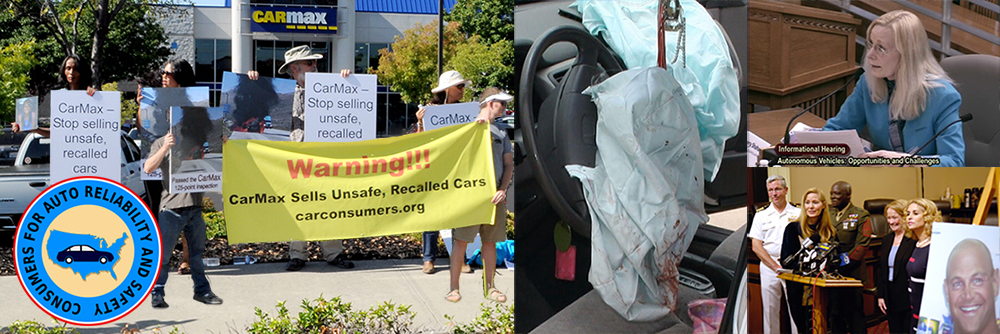
If you think this scenario sounds far-fetched, think again. GM dealers are opposing the same federal legislation (S 921), named for Raechel and Jacqueline Houck —  two sisters, ages 20 and 24, who were killed by a recalled rental car. GM dealers are also fighting against a popular bill currently pending in California (SB 686) that would stop them from selling, renting, leasing, or loaning unsafe, recalled used cars to consumers.

Fe Lastrella, who lost her son, daughter, granddaughter (age 13) and son-in-law in a horrific crash near San Diego, after a Toyota dealer loaned her family a runaway Lexus while their new Lexus was in the dealership for routine maintenance, gave heartbreaking testimony in favor of the California loaner car safety measure.

Dealer lobbyists dismissed her testimony as irrelevant, because the crash involved a Lexus that had not yet been recalled — although her family’s tragedy raised public awareness and sparked a massive Toyota recall.  Instead, they argued that anytime there is a delay in getting repair parts, they should not be expected to stop loaning unsafe, recalled vehicles to consumers.

According to statewide polling, 88% of likely California voters disagree, and favor banning dealers from foisting unsafe, recalled vehicles into their customers. Of those, 78% “strongly” favor the restrictions.

Apparently GM and its dealers think the media can only focus on one auto safety disaster story at a time, and won’t connect the dots.

Video of US Senate hearing — GM represented by Mitch Bainwol, from Alliance of Auto Manufacturers, including GM

Senator Barbara Boxer asks: Should a rental car company be able to rent vehicles to the public when they’re under a safety recall?  Responses from auto manufacturers and dealers

Testimony of Fe Lastrella, who lost her daughter, son, granddaughter (age) 13 and son-in-law in horrific crash, due to an unsafe loaner car from Bob Baker Toyota / Lexus

Dealer lobbyists: Don’t stop us from renting, leasing, selling, or loaning unsafe recalled autos to consumers

Other vehicles besides the Chevy Cobalt included in the safety recall (so far):  2007 Pontiac G5s, 2003-7 Saturn Ions, 2006-7 Chevrolet HHRs, 2006-7 Pontiac Solstices, and 2007 Saturn Skys,

GM delayed Cobalt safety recall, while fatalities mounted

General Motors issued a rare apology, after being hit with a barrage of news reports about faulty ignition switches in the popular Chevy Cobalt, that led to at least 13 deaths. GM engineers first discovered the defect in 2004.

Merely jostling the key in the ignition could lead the car to shut down, including disabling the air bags. But for years, GM denied that any defect existed and failed to issue a safety recall. Instead, the company merely issued a “technical service bulletin,” while their customers continued to die.

The defect means that at the very moment when drivers and passengers need the lifesaving protection air bags provide — in the milliseconds after a crash — the air bags would not inflate.

Twenty-nine year old Brooke Melton of Georgia was killed when she was driving to her boyfriend’s house. A 16-year-old died in a crash in Maryland when the ignition switch turned off and the air bag failed to deploy.

Buyer beware: NEVER trust that a dealer will have the safety recall repairs performed before selling you a car that is being recalled. Dealers are so eager to make a buck, fast, they are unwilling to delay sales long enough to get the safety recall repairs done — for FREE.

Plus — dealers are blocking legislation in Washington, DC and in California to stop them from renting, selling, leasing, or loaning unsafe, recalled vehicles to consumers, until they’ve been repaired.

CARS’ tips on how to buy a safe, reliable used car — without having to risk going to a dealer:

Top 12 used car buying tips

Dealers play “used car roulette” with customers’ lives — and oppose legislation to make them stop

Did a dealer sell you an unsafe, recalled car? We want to hear your story. Contact CARS


GM issues safety recall over faulty ignition switches

General Motors is recalling nearly 780,000 compact cars in the US and Canada due to a faulty ignition switch. The switch can make the engine shut off without warning, causing a crash. The recalled vehicles are 2005 – 2007 Chevrolet Cobalts and 2007 Pontiac G-5s.

GM has acknowledged that 6 people have died in 22 crashes, linked to the problem.

Even something as simple as riding on rough roads or having other keys on the key ring can trigger the ignition switch to move out of the “run” position, cutting off both the engine and electrical power.

As required under federal law, GM will replace the ignition switches for free, through their franchised car dealers. However, it remains to be seen when the dealers will obtain sufficient parts to perform the safety recall repairs.

Meanwhile, GM is urging owners of the recalled vehicles to remove other items from the key rings for the ignition keys, pending repairs.

NOTE: If you are shopping for a used car, NEVER trust the dealer to ensure that the safety recall repairs have been performed. Dealers keep being caught selling unsafe, recalled vehicles to consumers — including so-called “certified” used cars.

Plus — dealers are actively opposing legislation in Washington, DC and in California that would prohibit them from renting, selling, leasing, or loaning unsafe, recalled vehicles to consumers, unless the safety recall repairs have been performed first.

CARS’ tips on how to buy a safe, reliable used car — without having to risk going to a dealer:

Top 12 used car buying tips

Dealers playing “used car roulette” with customers’ lives — and opposing legislation to make them stop

Did a dealer sell you an unsafe, recalled car?  We want to hear your story.  Contact CARS