Bought an auto lemon in California? Most lemon owners have to do more to get a refund.

CONSUMER ALERT for California auto and recreational vehicle lemon owners!! Don’t get stuck with a defective lemon car because you skipped this step.

Auto and RV manufacturers won major changes to California’s auto lemon law that make it harder for most owners of seriously defective “lemon” vehicles to get warranty repairs or a refund. The changes apply to lemon owners who purchase vehicles from:

General Motors, Ford, Fiat Chrysler / Stellantis (FCA), Hyundai, Infiniti, Isuzu, Kia, Mercedes-Benz, Mitsubishi, Nissan, Subaru, and other manufacturers who opted in to the new, anti-consumer version of the law.

The California Department of Consumer Affairs has posted a list of auto manufacturers who opted in to the new law. If the manufacturer of your car is on the list, your life as a consumer is now more complicated.

Before the changes to the law took effect, all you had to do was to take your faulty car to a manufacturer-authorized repair facility (usually one of their franchised dealerships) for repairs. The manufacturers were responsible for tracking the repairs and offering to “promptly” buy back vehicles that qualified as lemons. That makes sense, since the manufacturers are the ones that produce the defective vehicles.  They also review and approve warranty repairs, including reimbursing their dealers for performing repairs. Plus they have their own attorneys, who should be familiar with the lemon law.

What has changed? 

Now, most lemon owners are required to also notify the manufacturer directly, IN WRITING, in order to have the full protection of the lemon law. You must provide specific information, including:

  • The vehicle owner’s name.
  • The Vehicle Identification Number, or VIN, which must be “accurate.” You can find the VIN on a plate on the dashboard, and in the sales documents. It’s 17 numbers and letters. Take time to double-check that the VIN is correct.
  • A “brief summary of the repair history and problems with the vehicle.” It’s not clear from the new law exactly what will do the job. We suggest that you provide a complete list of all the problems that you have experienced, and of each of the times you attempted to get the vehicle fixed.
  • A demand that the manufacturer buy back the lemon, or provide a replacement vehicle.  It’s not enough to tell the dealer or manufacturer “I don’t want this car anymore,”  “I’m afraid to drive this car,” or “This car is a lemon.” You need to tell the manufacturer IN WRITING that you are demanding a buy back or replacement vehicle.

You must send this written message to one of two places:

By email:  to the email address that the manufacturer of your defective vehicle has provided, which shows up on this list.

By snail mail: “by certified or registered mail, return receipt requested, to the address provided by the manufacturer in the owner’s manual or warranty booklet.” The contact name and mailing address are also posted here, on the website for the California Department of Consumer Affairs.

When you send the written notice, you must still have possession of the vehicle, so don’t wait until you have traded it in to the dealership or sold it to someone else. You are also required to keep the car for at least 30 days from when the manufacturer has received the written notice.*

Plus you must inform the buyer IN WRITING about the problems you experienced with the car — even if it’s the dealer where you’ve been taking the car for repairs.**

Is calling the manufacturer’s toll-free number enough? NO!!

Even if you have called the manufacturer’s customer service number over and over again, and talked to agents of the manufacturer who say they have opened a case in your name, and they will get back to you, that is no longer enough to preserve all of the protections you need, under the lemon law. 

If you don’t send a written notice that complies with the new law, the manufacturer can get away with refusing to fix your lemon or buy it back, without facing the civil penalty for willfully violating the lemon law. The possibility of having to pay a penalty is the #1 incentive for manufacturers to do the right thing when you have a lemon. Unless they face a significant penalty, they have little to lose by failing to fix your car or give you a refund.

Why do auto manufacturers want you to have to write directly to them, before you can benefit from the lemon law?

The reason the manufacturers desired a change in the law to require lemon owners to write to them directly was to make it super easy for them to screen out vehicle owners who haven’t taken that additional new step, and refuse to pay for warranty repairs to fix their cars — reducing their warranty costs. 
 
Auto manufacturers know that most lemon owners will not be aware of the new requirement, or write to them and provide all of the required information, so they can get away with stonewalling and giving consumers the run-around, in hopes they will give up and trade in their defective cars at a huge loss.
 
Not surprisingly, the auto manufacturers who steered the lobbying effort to weaken California’s auto lemon law have the worst record of producing the most lemons, having to issue the most safety recalls, and having the highest warranty costs.
 
General Motors and Ford steered the battle to change the law. In the first half of 2025, Ford had warranty costs of over $2.8 billion and GM had warranty costs of over $2.5 billion.
 
In 2025, Ford broke records for having to issue safety recalls, recalling nearly 13 million vehicles due to serious safety defects — more than the next 9 auto brands combined.
 
How did the auto manufacturers get CA legislators to vote for weakening the lemon law?
 
For decades, CARS succeeded in not only blocking anti-consumer changes to California’s auto lemon law, but in expanding the law to cover vehicles purchased for business use and to include protections for military servicemembers stationed in, or deployed from, California.  
 
However, the Consumer Attorneys of  California (CAOC) sided with GM and Ford over the changes to the law, under threat of a ballot initiative that would have capped their attorneys’ fees — threatening their incomes.
 
The changes to the law were introduced using a sleazy tactic called a “gut-and-amend”  — stripping out the contents of a bill on an unrelated topic, and inserting the unpopular provisions — just two weeks before the end of the legislative session, when the fate of hundreds of bills was being decided all at once.  Many legislators complained about the unfair, rushed process and having to make a decision on such an important issue without the usual months-long scrutiny such a bill should get.
 
CARS worked night and day and fought back hard against the changes, which were also opposed by manufacturers such as Toyota (which produces relatively few lemons compared with GM and Ford), but most legislators caved in to GM, Ford, and the CAOC. Notable exceptions, who sided with consumers: Assemblymembers Rebecca Bauer-Kahan, Dr. Jasmeet Bains, Jacquie Irwin, and Cottie Petrie-Norris, and Senators Marie Alvarado-Gil, Angelique Ashby, Susan Talamantes Eggman, and Roger Niello.
 
Governor Newsom expressed reservations about the bill and insisted that the legislature enact another bill (SB 26) to allow auto manufacturers to opt out, as a condition of signing the bill.
 
 
* Here’s the actual quotation from the GM-Ford-CAOC changes to the lemon law (AB 1755):
 
California Code of Civil Procedure Section 871.24.
 (a) At least 30 days prior to the commencement of an action seeking civil penalties under subdivision (c) of Section 1794 of the Civil Code, the consumer shall do all of the following:
 
(1) Notify the manufacturer of the consumer’s name, the accurate Vehicle Identification Number (”VIN”) of the motor vehicle, and a brief summary of the repair history and problems with the motor vehicle.
 
(2) Demand that the manufacturer repurchase or replace the motor vehicle.
 
(b) Minor deviations in the notice submitted pursuant to subdivision (a) shall not disqualify consumers from seeking civil penalties.
 
(c) At the time that notice submitted pursuant to subdivision (a) is sent, the consumer shall have possession of the motor vehicle.
 
(d) The notice required by subdivision (a) shall be in writing and shall be sent either by email to the email address prominently displayed on the manufacturer’s website for this purpose or by certified or registered mail, return receipt requested, to the address provided by the manufacturer in the owner’s manual or warranty booklet. The notice information on the manufacturer’s website, owner’s manual, and warranty booklet shall be provided in both English and Spanish.
 
** Here’s the actual quotation from the opt-out bill, SB 26, that requires auto lemon owners to inform the buyers IN WRITING about the problems with the vehicle and any legal action they may bring — even if the buyer is the dealer who has been attempting to repair the car, and is already familiar with its history.
 
(i) If a consumer sells their vehicle as authorized by subdivision (g), the consumer may not seek civil penalties under subdivision (c) of Section 1794 of the Civil Code unless the consumer provided to the prospective buyer or recipient of the vehicle, prior to the sale, written notice of the basis for the consumer’s request for restitution or replacement from the manufacturer and of any pending action described in subdivision (a) of Section 871.20.
 

Will Governor Newsom VETO attack on California’s auto lemon law?

Auto manufacturers attack California’s landmark auto lemon law
Pro-consumer / auto safety organizations urge Gov. Newsom to veto SB 71

Auto manufacturers who produce seriously defective vehicles are backing legislation on Governor Gavin Newsom’s desk that would drastically weaken the ability of hapless victims of lemon automobiles to use California’s auto lemon law to get a refund. If Governor Newsom signs the bill (SB 71) into law, millions of California vehicle owners would face a much higher risk of being stuck with lemon autos that are unreliable and often unsafe to drive.

In a letter sent to legislators in Sacramento, the Alliance for Automotive Innovation — the trade association for dozens of international auto manufacturers — argues for passage of SB 71, authored by Senator Tom Umberg (D-Santa Ana), the powerful Chair of the California State Senate Committee on the Judiciary.

SB 71 would take away the ability of consumers who purchase faulty lemon cars for less than $35,000 to access “unlimited civil” courts, where they can easily get legal representation — usually at no cost to them — and may be awarded up to double their damages as a civil penalty, if they win and prove that the manufacturer’s refusal to promptly comply with the lemon law was “willful.”

Instead, consumers whose vehicles cost less than $35,000 would be forced to submit their cases to “limited civil” courts where they would face a number of procedural hurdles that usually make it impossible for them to win. For example, they are unlikely to be able to get enough discovery to prove their case. This means that scofflaw auto manufacturers who produce problem-riddled lemon cars priced below $35,000 would be able to get away with foisting them off on California car buyers and refusing to honor their warranties and fix them. Thus, auto giants would save potentially tens of millions of dollars in auto repair costs they would otherwise have to spend to fix problem cars under warranty.

If Governor Newsom signs SB 71 into law, he would be the first California governor to weaken protections for California’s car buyers under California’s landmark auto lemon law, widely regarded as the best in the nation. In the past, governors of both major political parties, democrats and republicans alike, have signed bills to improve and expand protections against defective lemon cars, starting with Governor Ronald Reagan, who signed California’s Song-Beverly Consumer Warranty Act — the original “lemon law” — in 1970.

The timing couldn’t be worse, since consumer surveys show increasing dissatisfaction and complaints about major defects in new vehicles, which are prone to myriad  problems caused by faulty electronics and software programming.

According to J.D. Power’s annual survey of initial quality among motor vehicles:
“In the IQS, J.D. Power ranks automakers based on verified-owner responses, calculating for each a problems-per-100-vehicles (PP100) score. Looking at recent study results, the number of problems increased by 18 PP100 between 2021 and 2022 and climbed a massive 30 PP100 from 2022 to 2023. That’s nearly 50 PP100 combined in just two years. Automakers are seeing more persistent problems with their new technologies.New Tech Drives Major Increase in Vehicle Quality Issues, JD Power report June 22, 2023.

According to the official analyses of SB 71, the only supporters are debt collectors and auto manufacturers and suppliers.

CARS and other non-profit organizations who give consumers a voice in the legislative process are fighting back. We’re urging Governor Newsom to veto SB 71. Here’s our letter to Governor Newsom. The more Californians the Governor and his staff hear from, the better.

ACTION ALERT!!
Save YOUR right to fight back against greedy auto manufacturers
Don’t let auto giants stick you with an unsafe, defective lemon car
Save California’s auto lemon law – act NOW!!

What can you to make YOUR voice heard and save California’s auto lemon law, so you can fight back if your “dream car” turns out to be a lemon?

Send a brief personalized e-mail message to California Governor Gavin Newsom, here. Under topic, choose “An active bill” and then “SB 71”. Where it asks for your position, choose “CON.” In your comments, let the Governor know that you live in California and urge him to VETO SB 71. Use your own words to explain why. For example, “I spent over $30,000 to buy a brand new car, and it was in the shop for repairs for over two months. Ford refuses to buy it back. California needs a strong auto lemon law. Don’t weaken it. I urge you to VETO SB 71.”

Do you live where wildfires pose a threat? Beware of CarMax and their firebomb cars and trucks!

Since 2015, auto manufacturers have recalled more than 26.5 million vehicles due to defects that can cause them to burst into flames. Some manufacturers recommend that the owners park the cars outside, where they may be less likely to burn down homes.  Recently, General Motors warned owners of 2017 – 2019 Chevy Bolts with faulty batteries they should park them outside, after battery fires erupted in Bolts.

But beware: if you buy an unrepaired, recalled firebomb car from a car dealer like CarMax, and it catches on fire and burns down your home, or destroys a whole town, they will try to pin the blame on you.

This is a lesson that Californian Anthony Santos found out the hard way, after a Ford F-150 pickup he purchased from CarMax caught on fire in his driveway and caused over $200,000 in damage to the pickup, his garage, and his home. Fortunately, he and his children were able to escape the flames.

Before he bought the pickup from CarMax, Ford had issued a safety recall because the truck had a dangerous defect that made it prone to catching on fire without any warning.

CarMax failed to get the FREE safety recall repair done before selling the pickup to Mr. Santos. Despite neglecting to get the repairs done, CarMax advertised that the pickup had passed CarMax’s “125 point inspection.” This of course would lead car buyers to believe that it must at least be safe and free from known, hazardous safety recall defects.

After the truck caught on fire, CarMax tried to pin the blame on Mr. Santos for not finding out about the recall, taking his truck to a Ford dealership, and getting the safety recall repair done himself. Mr. Santos fought back and sued CarMax, but eventually the huge, publicly traded auto dealership chain won, on a technicality.

Bottom line: Buying cars from CarMax is risky, especially if you live where there’s a serious threat of wildfires.

P.S. Another hazard: Sometimes car buyers have experienced lengthy delays in getting safety recalls fixed, due to severe shortages of repair parts.  CARS has heard from unfortunate car buyers who ended up waiting over a year for a repair. Meanwhile, they were afraid to drive their own cars. In some states, legislators have introduced bills to make driving your own car illegal, if the safety recall repairs haven’t been done.

Learn more: NBC Bay Area: Risks of Buying a Used Car and What the Dealership Isn’t Telling You

Did you pay too much for your car?

You work hard for your money. You have better things to do with it than give it away to a greedy, conniving car dealer. But if you shopped at an auto dealership last year, chances are you paid too much. By a lot.

Car dealers across the nation are crowing about the record-breaking profits they’re making during the pandemic.  Their fat profits are being fueled by people who are flocking to buy cars — understandably fearful about taking public transportation, flying in airplanes, or using ride-shares or other modes of transportation where they risk being in an enclosed space with others who may be spreading the Coronavirus.

According to Automotive News, “AutoNation, of Ft. Lauderdale, Fla., hit a record-high quarterly F&I [Finance and Insurance] profit per vehicle retailed on a same-store basis with an average of $2,172, an increase of 12 percent, or $240, from year-ago figures.”

AutoNation is publicly traded on Wall Street. They operate over 315 new car dealerships nationwide. Over the years, their biggest investor has included an entity affiliated with Microsoft founder Bill Gates, one of the wealthiest men in the world.

Keep in mind that $2,172 is just AutoNation’s profit on the financing and insurance products they foist off on consumers. They also profit handsomely on the price of the car itself.

Imagine what you could do with $2,172.  Maybe feed your family for months. Pay college tuition and get a better job. Get a much better vehicle you really like, that’s friendlier to the environment and safer for you and your family.

Plus — something AutoNation apparently doesn’t like anyone to mention publicly — they deliberately sell their customers cars with dangerous unrepaired safety recall defects. Especially cars with killer safety defects that you cannot get fixed because there are huge shortages of repair parts.

So if you buy that recalled car, there’s no way you can get it made safe. Sometimes the parts delays can last for months, or over a year. Meanwhile, you are your family are at serious risk of being injured or killed.

Please don’t assume you will have time to get the recall fixed before tragedy strikes. Auto safety defects are like ticking time bombs.  In San Diego, four members of one family –a highway patrol officer, his wife, their 13-year-old daughter, and the officer’s brother-in-law — were killed by an unsafe car the same day, just hours after a dealership handed the CHP officer the keys. They were on their way to a soccer match when the fatal defect happened.

If you don’t feel like overpaying for a dangerous deathtrap, please consider buying from another consumer and avoiding car dealers altogether. You still have to be careful, and do your homework. But at least you won’t be stuck dealing with a dealership chain that is out to maximize their profits at your expense.

How can you take control of your car buying experience, and get a good deal on a nice, safe, reliable used car? Check out these step-by-step tips from pro-consumer experts.

Your life is precious. You deserve to get the full value of what you pay for. Stay safe — and save!

Did CarMax sell you an unsafe car?

You’ve probably noticed the ads. They’re on TV, at sports events, and on the radio.  CarMax has an enormous ad budget and spends millions to paint  a rosy picture about the cars it sells. But behind all the hype, dangerous cars with killer safety defects are lurking.

CarMax boasts that all the vehicles it offers for sale must pass a rigorous inspection, before they can be sold as “CarMax Quality Certified” vehicles. But what they don’t want you to know is that they fail to get the FREE safety recall repairs done.

Instead, they charge top dollar for cars with killer safety defects. In fact, according to a recent survey of CarMax vehicles for sale in California, Massachusetts, and Connecticut, over 25% of the vehicles they offer for sale have unrepaired safety recalls.  One truck had 6 unrepaired safety recall defects — a deathtrap on wheels.

CarMax is the largest retailer of used cars in the U.S. They took in over $15 billion last year, but they don’t care enough about the safety of their customers to hire employees and give them the job of delivering cars to franchised car dealers for repairs and picking them up when they’re ready.  Instead, they are perfectly willing to put the lives of their customers, their families and friends and other passengers, and others who share the roads, at risk, to maximize their profits.

One of the most common defects in CarMax cars: hazardous Takata airbags that are prone to exploding with excessive force, spewing metal fragments at drivers and passengers. Over 20 people have been killed by these ticking automotive time bombs.  Here’s what can happen at any time to hapless consumers who end up riding in cars with the faulty airbags:

People Magazine: Scott Eastwood’s girlfriend Jewel Brangman died from faulty airbag in crash.

The crash that killed Jewel was basically a fender-bender. The recalled Honda that caused Jewel’s death was sandwiched between two other cars, in a low-speed crash. Everyone else walked away. But a metal fragment from the exploding airbag sliced into Jewel’s neck and she bled to death.

The only way CarMax is going to stop endangering lives is for their own customers to speak up. We hope that happens before there are more tragedies like the one that killed Jewel Brangman.

Did CarMax sell you a car with an unrepaired safety recall?  If they did, we want to hear from you. Such sales are very likely a violation of state consumer protection laws. We encourage you to fight back.

Here’s where to contact CARS. Thank you for helping save lives!


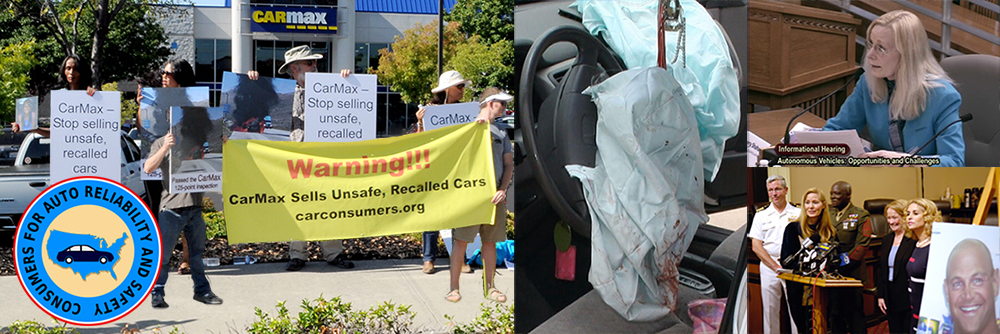
CarMax sells unsafe, recalled cars

CarMax, the nation’s largest retailer of used cars, claims all its vehicles must pass a rigorous “125 point inspection.” It also advertises that all its cars are so-called “CarMax Quality Certified.”

But instead of living up to its hype, CarMax is selling LOTS of recalled cars with lethal safety defects. CarMax has a gambling addiction. It continues to play “recalled car roulette” with its customers’ lives.

Among the defects on cars waiting for sale on CarMax’s lots:

  • sticking accelerator pedals
  • catching on fire
  • hoods that fly up in traffic
  • faulty brakes
  • steering loss
  • stalling in traffic
  •  seat belts that fall apart in a crash
  • air bags that explode with excessive force and cause blindness or death

An ABC 20/20 undercover investigation found unrepaired recalled vehicles for sale on CarMax’s lot in Hartford, Connecticut. CarMax’s excuse? It can’t be bothered waiting for the FREE repairs.

ABC 20/20 exposes CarMax’s sales of damaged cars and unsafe, recalled cars

CarMax Admits It Sells Unsafe, Recalled Cars
So — how can a car that’s so unsafe pass their so-called  “rigorous 125+ point inspection”? No one seems to know…and CarMax refuses to go on camera…

From ABC NEWS RADIO:

” CarMax says it has transformed the used car buying experience with no haggling pricing and financing and its “125+ point” inspection process to make sure drivers don’t end up with a lemon. But consumer advocates say CarMax sales reps don’t always disclose the complete history and condition of the vehicles they sell.

A 20/20 investigation found instances on two CarMax lots where vehicles were being sold with reportedly significant accident histories or unrepaired safety recall issues….

When it came to outstanding safety recalls, the Hartford dealership salesman was recorded on hidden camera telling Benitez that CarMax is unable to sell a car with a major safety recall. “We can’t even sell it until that’s taken care of,” he said. “We take care of any kind of safety concern prior to the car even being out here.”

However, a check of a federal government website revealed that the Toyota Camry at the Hartford CarMax dealership had three outstanding safety recalls on it at the time of our visit, including one for a power switch that could overheat and melt, possibly resulting in a fire. Five other vehicles sitting on the lot also had unfixed safety recalls, according to the government website.

CarMax declined an interview but told 20/20 in a statement that it doesn’t automatically fix recall vehicles before selling them and only does so if a customer requests it. CarMax says it does inform consumers about any open recalls and recently upgraded its website so customers can look up open recalls online through the government database. CarMax also says it retrained its staff on its recall policy.

A coalition of consumer and safety groups filed a petition with the Federal Trade Commission this June, urging the agency to investigate CarMax’s safety recall policy. Rosemary Shahan, head of Consumers for Auto Reliability and Safety (CARS), is calling on the FTC to require CarMax to have all safety recall vehicles repaired before selling them to consumers. “CarMax sells vehicles that are under safety recall without bothering to fix them,” said Shahan. “If they wanted to do it right, it would be very easy for them to do it right.” (Emphasis added)

Read more: ABC 20/20:  What Do Some CarMax Sales Reps Tell  Consumers?

“check engine” light woes

You’re a smart consumer. So before you buy that used car, you take it for a test drive.  You notice that there are no warning lights on the dashboard. You think everything is fine, and you buy the car.

But — shortly after you drive it home, the “check engine” light comes on. This spells trouble. BIG trouble. This scenario is playing out all over the country. It’s become a frequent complaint among used car buyers. “I just bought it and now the ‘check engine’ light is on.”  Adding to the woes experienced by consumers who are victims of “check engine-itis” — the repairs to get that pesky light to go off can cost $3,000 — $4,000 or more.

Margie Y of Hawthorne, CA contacted CARS and said she bought a used Toyota for her daughter, as a present for her 21st birthday, from a local dealership. Within a day, the “check engine” light came on. Then the alternator blew up, and the car caught on fire. When she had the partly charred Toyota towed to a mechanic, he said it needed a new alternator, catalytic converter, and solenoid — at an estimated cost of over $2400.  Money she didn’t have, since she had paid $6200 cash for the Flaming Toyota, and also traded in a vehicle that was running fine, plus had paid $300 for the tow.

Unfortunately, this story is all too familiar. So — what’s happening?  According to automotive experts, unscrupulous dealers buy “scan tools” over the internet that allow them to simply wipe out the error codes that trigger the “check engine” light. Then they sell the car.  As soon as it’s driven a short distance, the error codes register and — on goes the dashboard warning light.  Some dealers don’t bother to buy the scan tools. They just disconnect the battery, erasing the error codes and getting the “check engine” light to go off just long enough to foist the car off onto an unsuspecting used car buyer.

Not only are the dealers cheating their customers, they’re also falsifying smog test results and polluting the air. They know that chances are good their customers won’t be able to pay for the expensive repairs, and will end up driving the car despite the fact it doesn’t meet emissions standards.  The day of reckoning may come when the hapless consumer tries to register it, and it won’t pass the smog test. But by then, the dealer figures it will be too late for the consumer to take them to court.

What can you do to avoid becoming a victim of “check engine-itis”?  The most effective single thing you can do is to insist on getting your own trusted mechanic to inspect the car before you buy. They should be able to detect the fact the error codes have been wiped clean, and also do a check of the emissions system that will turn up the problems.  Where can you find a good, reliable mechanic?  Car Talk’s Mechanics Files is a terrific resource, where you can find the best mechanics in your area, based on reviews written by their own customers.

Check Car Talk’s Mechanics Files to find a reliable mechanic — before you buy

Tell the seller that you want them to take the car to YOUR mechanic before you’ll agree to buy.  If they balk at that, or try to talk you out of it, well, that’s why God gave you feet — so you can walk away from there. Pronto.  There are plenty of good used cars for sale.You don’t need to get stuck with one that will cause you hassles and headaches.

Unsafe, Recalled Used Cars for Sale on Dealer Lots

Used car dealers across the nation persist in foisting off unsafe, recalled vehicles on an unsuspecting public. Motor vehicles rank among the most hazardous consumer products in the nation, in terms of fatalities, serious and debilitating injuries, and economic costs to our country.

Fortunately, car dealers are prohibited by federal law from selling or leasing NEW cars that are being recalled by the manufacturer. But unfortunately, there is no such law to protect USED car buyers.

Each year, about 40 million people purchase used cars. But the powerful auto dealer lobby — which received billions of taxpayer dollars during the Great Recession — has blocked attempts in Congress to protect used car buyers from unsafe, defective recalled cars being sold at dealerships.

News organizations have repeatedly identified this problem. In 2010, the non-partisan U.S. Government Accountability Office (GAO) recommended that Congress address the threat posed by unsafe, recalled used cars. But so far, Congress has failed to act. Auto dealers are not even required to report fatal or injury crashes involving recalled vehicles they sell to the public, to the National Highway Traffic Safety Administration.

CBS’ Early Show investigated sales of recalled, used cars and found unfixed, recalled cars on lots scattered across the country.  When they asked if the cars were being recalled, sales personnel assured them that they wouldn’t have them for sale if they were being recalled. If only that were true.

According to CBS’ Early Show: “A dealer in Oklahoma sold Tabitha Gordon a used Durango in 2009. She was driving with her son, Kaden, when the lights, wipers and locks went haywire.  Gordon said of the incident, “I felt like I was in a twilight zone. … The plastic that covers the speedometer had popped, and smoke started billowing into the vehicle.”

She managed to pull over and get Kaden out as the car caught on fire. [“Early Show” Consumer Correspondent Susan] Koeppen said it turns out Gordon was sold a car that had been recalled for an electrical defect.  “We were told that it was safe and it would be a safe vehicle for our family,” Gordon said. “And it wasn’t, it was far from it.

Watch video: CBS Early Show — Recalled Used Cars Up For Sale

Can you imagine how awful it would be, for your car to catch on fire, when you have your child strapped in a child safety seat in the back? What if you are driving with several children who are strapped in? Would you be able to get all of them out in time, before the car explodes?

Auto dealers complain that it’s too much bother for them to find out if a car is being recalled and get it fixed, before offering it for sale. They would rather risk your life, and your family’s safety, than take the time to call the manufacturer’s toll free number and check the car’s status, or visit the manufacturer’s website, online, and get the car fixed — for free.

CARS believes that even if you can’t afford a new car, or if you simply decide that a used car is a better deal, you and your family still deserve to be safe.

What can you to to protect yourself from unsafe, recalled used cars?  When you find a car you like,  NEVER take the car dealer’s word for it that the car does not have a safety recall pending.  As reporters have repeatedly documented, car dealers are prone to lying about safety recalls, even if you ask them face-to-face about a specific car.

Instead, BEFORE you buy, do your own research.  Note the Vehicle Identification Number (VIN), which is stamped on a small plate on the dashboard, visible through the windshield. Call the auto manufacturer’s toll-free number and ask if all the recall work has already been done. Or check the auto manufacturer’s website, under “safety recalls,” and enter the VIN.  You can also contact a local dealership that sells that make of vehicle, and ask them to double-check for you. Since new car dealers get paid to do recall repairs on makes they sell, at least they have some incentive to tell you the truth.

Read More: CARS tips for used car buyers